


Longevity Training — How to Build Fitness for the Years Ahead

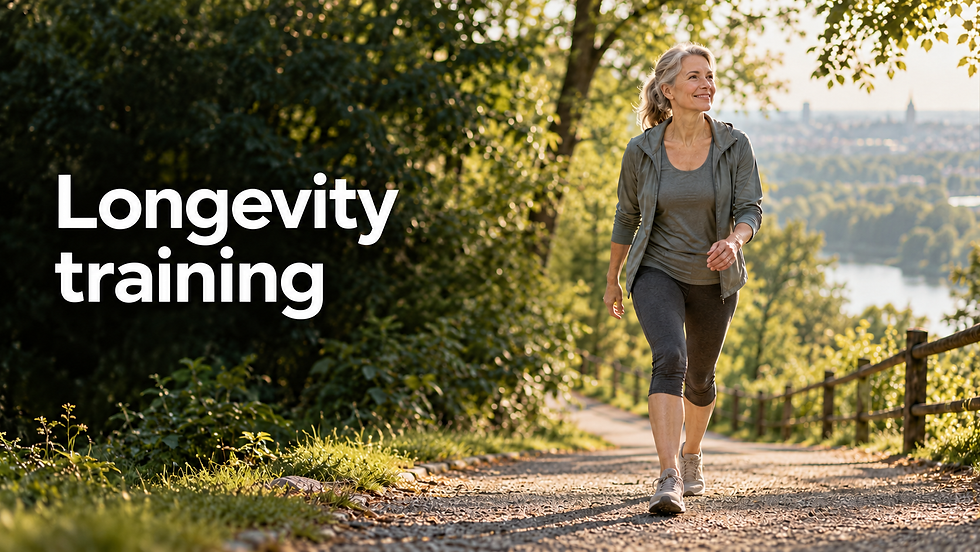
Climbing stairs without getting out of breath, carrying your own groceries, or hiking in your sixties. These everyday abilities depend partly on muscular strength, endurance, and balance. Developing them early can help you maintain greater independence in the decades ahead.
Longevity training is an approach to physical activity aimed at preserving health and physical function for as long as possible. It combines strength training, aerobic exercise, and movement control. Its foundations are consistency and gradually adjusting the demands of exercise to your abilities.
What Does Science Say About Exercise and Longevity?
Research consistently shows that physically active people have a lower risk of premature death and many chronic diseases. In a large observational study of American adults, meeting the recommendations for both aerobic activity and muscle-strengthening exercise was associated with a lower risk of death than meeting neither recommendation. Study published in The BMJ.
These findings describe relationships across populations. They cannot promise any individual a specific number of extra years of life. They do, however, provide a strong basis for treating physical activity as an important part of looking after your health.
Muscular Strength — A Foundation for Everyday Independence
Getting out of an armchair, carrying a bag, or stepping onto a high step requires you to work against resistance. Strength training develops this ability.
A practical routine might include chair squats, step-ups, resistance band rows, and wall push-ups. Exercises should involve different muscle groups and be challenging enough while allowing you to maintain control of the movement. As the effort becomes easier, resistance or repetitions can gradually increase.
Although you can start with simple exercises, it is worth seeking support from a qualified trainer who can tailor a plan to your fitness, experience, and limitations. A trainer can help you learn good technique, select appropriate resistance, sets, and repetitions, and plan progression: gradually increasing the demands as your body adapts. Well-chosen exercises, an appropriate exercise dose, and carefully planned progression are fundamental to effective and safe training. Your plan should be reviewed regularly in light of your progress and recovery.
The value of muscle-strengthening exercise extends beyond physical function. A meta-analysis of cohort studies found an association with a lower risk of death and certain chronic diseases. The authors also highlighted the limitations of observational evidence. Research review in the British Journal of Sports Medicine.
Endurance — How Your Body Handles Physical Effort
Cardiorespiratory fitness describes your body’s ability to deliver and use oxygen during physical activity. You experience it in everyday life when walking briskly or climbing a long hill.
A 2024 overview of meta-analyses, covering 199 unique cohort studies, found a clear association between higher cardiorespiratory fitness and a lower risk of premature death and many health problems. This is one reason why developing endurance is an important part of longevity training. Scientific review.
You can start with walking, cycling, swimming, or dancing. Choosing an activity you enjoy makes it easier to keep doing it regularly.
Support from a trainer can also be valuable for endurance training. A qualified professional can help you choose the type of activity, its intensity, duration, and frequency, then plan gradual progression. They can also account for strength training and rest so that your overall training load matches your capabilities. A simple walk can be a good starting point, while adjusting the amount and intensity of exercise to your body’s response helps you develop fitness purposefully and reduce the risk of overuse.
Balance and Movement Control
Physical function also includes the ability to remain stable, change direction, and navigate obstacles safely. Balance exercises, such as standing on one leg near a stable support, are therefore worth including in your routine.
For adults aged 65 and over, the WHO recommends varied physical activity that emphasises balance and strength on at least three days a week. The aim is to maintain functional ability and reduce the risk of falls. WHO guidelines.
How Much Exercise Do You Need, and Where Should You Start?
According to the WHO, adults should aim for 150–300 minutes of moderate-intensity aerobic activity per week, or 75–150 minutes of vigorous activity, alongside exercises that strengthen the major muscle groups on at least two days a week. Beginners can start with smaller amounts and build up gradually. Physical activity recommendations.
A first step could be a ten-minute walk five times a week and two short strength sessions tailored to your current fitness. Over time, gradually extend your walks and increase the difficulty of your exercises. Make room for rest, too: your plan should allow you to recover and return to activity consistently.
Think of one activity you want to enjoy comfortably in 20 years. Hiking, dancing, playing with your grandchildren? Your answer is a useful starting point for deciding which physical abilities to build today.
Comments